


The biotech market is back. The early-stage ecosystem isn't
The biotech market is back. The early-stage ecosystem isn't
BioTalent CEO James Cox recently analysed 14 months of disclosed biopharma financings — 785 deals, $42.7bn raised — to understand where capital is flowing. His Jan–Apr 2026 vs Jan–Apr 2025 comparison tells a revealing story:
- Total capital: $12.1bn → $14.5bn (+19%)
- Deal count: 246 → 234 (-5%)
- Median round size: $20.6m → $32.8m (+59%)
- IPO proceeds: $1.2bn → $3.2bn (+168%)
Bigger cheques, fewer companies, increasing IPOs — on the surface, that looks like a healthy recovery. But James’s analysis reveals a much more uneven picture underneath.
Four hubs, four different stories
United States remains the clear market leader, taking $9.5bn (66% of all capital raised in Q1 2026) across 128 deals, up 16% year on year. As James notes, the depth of the US capital pool is the single most important variable in this industry, and nothing in the data suggests that’s about to change.
China is the breakout rising star. Capital raised jumped from $374m to $1.9bn year on year — nearly 5x — with three Q1 IPOs (Insilico Medicine, Suzhou Ribo, DIAGENS) leading the charge. In James’s view, China is no longer a peripheral player but a structural contributor to the global innovation economy, with over 60% of the world’s R&D pipeline now Chinese.
United Kingdom has pulled back. $1.4B raised in Q1 2025 dropped to $692m in Q1 2026, down 51%. James points to fewer mega rounds and a heavier reliance on smaller cheques as the underlying trend, beyond the base effect of Verdiva’s outsized $411m round in January 2025.
Europe (including Switzerland) raised $1.1bn, down 30% on the prior year. Germany and Belgium had strong starts — Agomab’s $200m IPO leading the way — but Switzerland represents the sharpest pullback of any major hub in James’s findings. Swiss biotech raised $462m in Jan–Apr 2025; the same period in 2026 yielded just $98m, a 79% drop. Having spent considerable time on the ground in Switzerland attending the Sachs CEO Forum in Zurich and the Zug Life Sciences Summit, as well as overseeing the opening of BioTalent’s new Swiss office, James had expected the data to look stronger. The ecosystem, he notes, hasn’t gone anywhere. The capital has.
The number that should worry the industry
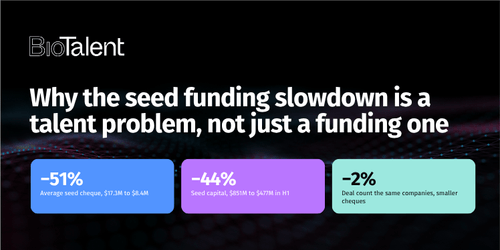
Stripping out the headline figure, James’s analysis highlights where the growth is coming from. Pre-Phase 3 capital — Seed, Series A, and Series B combined — is essentially flat year on year at $5.94bn vs $5.95bn. Every dollar of the +19% headline growth has come from later stages and IPOs, which together are up 52%. Seed and Pre-A funding is down 59%, with median seed round size falling from $5.5m to $4.8m.
For James, this is the finding that stands out most. The early stage is where innovation is strongest and the next generation of transformative companies are built, where scientific risk meets commercial ambition and where the clinical assets of the next decade are being seeded right now. If capital won’t show up at that end of the funnel, the pipeline three to five years out gets thinner regardless of how strong today’s IPO window looks.
Key takeaways
The flight to quality is real. Investors are writing bigger cheques into companies closer to value-inflection points. AI drug discovery attracted $1.3bn in Q1 alone, ADCs drew $1.2bn, while obesity and GLP-1 has cooled 91% year on year as the hype cycle moves on.
Geography is rebalancing. The US continues to dominate. China is filling space that European hubs are leaving on the table and, in James’s view, the EU and UK need to respond.
The early-stage gap isn’t getting enough attention. Bigger cheques later in the cycle are great for companies that have already made it. They don’t help the ones that haven’t yet, and that, James argues, is a structural problem the industry needs to confront.
As BioTalent works with life sciences organisations across these markets every day, these findings reflect what the team sees on the ground — the bar for early-stage companies is rising fast, and founders need to be ready for it earlier than ever.
See how BioTalent can help
Contact the BioTalent team today to discuss how these market shifts might affect your talent strategy.












NPS Score
70+ is considered world-class
76

Get in touch
Whether you're hiring or job hunting, we're here to make the process simple. Reach out and let's talk.
All Rights Reserved 2026 BioTalent
